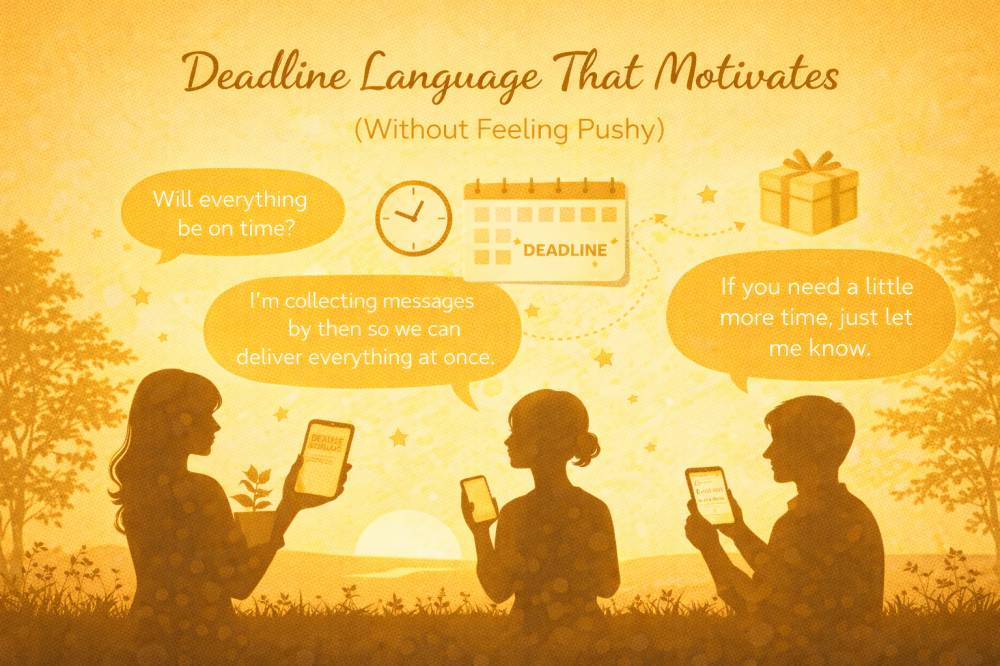
Deadlines can feel uncomfortable.
Most people worry that setting one will sound demanding, impatient, or overly rigid. But in practice, the opposite is usually true: clear deadlines help people follow through—especially when the deadline is framed with care.
Collect video messages from friends and family into one beautiful wall. Start free — pay only when you deliver.
A deadline isn’t pressure. It’s structure. And structure is often what turns good intentions into action.
A quick reassurance
You’re not rushing people.
You’re helping them understand when the moment matters.
Most contributors actually appreciate knowing:
-
How much time they have
-
When the gift will be delivered
-
Whether “later” is still an option
Clarity is kind.
Why deadlines help (even when they feel awkward)
Without a deadline, people tend to think:
-
“I’ll do it when I have more time.”
-
“This probably isn’t urgent.”
-
“I can come back to this later.”
With a deadline, they think:
-
“Okay, I know when this needs to be done.”
-
“This matters now.”
-
“I should carve out five minutes.”
Deadlines don’t force people. They focus them.
What makes deadline language feel gentle (not pushy)
Good deadline language does three things:
-
Explains the reason
-
Keeps the ask small
-
Leaves room for grace
When people understand why there’s a deadline, they’re far more likely to respect it.
A simple way to explain the deadline
One sentence is usually enough:
I’m collecting messages by a certain date so everything can be delivered together as one complete gift.
This reframes the deadline as part of the recipient’s experience—not a demand on contributors.
Deadline wording you can use as-is
Here are a few options that consistently land well. You only need one.
Clear and calm
If you’re able to add a short message by the deadline, it would really help everything come together.
Slightly firmer (still kind)
I’m hoping to collect messages by the deadline so the gift can be delivered on time.
Extra gentle
Totally understand if timing doesn’t work—if you do have a moment before the deadline, it would mean a lot.
All of these keep the door open while still signaling that timing matters.
Collect video messages from friends and family into one beautiful wall. Start free — pay only when you deliver.
How far out should the deadline be?
Most walls work best with:
-
7–10 days for the initial window
-
A reminder halfway through
-
A final nudge close to the end (if needed)
Shorter windows can work, but only if expectations are clear from the start.
What to say when someone asks for more time
This happens often, and it’s a good sign—it means they care.
A simple response works best:
That should be fine—if it ends up being a bit late, I’ll see what I can do.
You don’t need to promise anything. Just keep the tone supportive.
Handling late submissions (without stress)
Late submissions don’t mean you failed. They’re part of working with real people.
If a message comes in after the deadline:
-
Decide whether it can be included without disrupting delivery
-
If not, acknowledge it warmly anyway
People usually understand once they know the gift has already been delivered.
Common worries (so you don’t carry them)
“What if people feel pressured?”
Most won’t. Clear, respectful language reads as organized—not demanding.
“What if I’m being too rigid?”
Being rigid is refusing flexibility. Setting a deadline is simply setting expectations.
“What if I don’t want to bother people?”
You’re not bothering them—you’re inviting them to be part of something meaningful.
Next best action
Choose a clear deadline, mention it once in your follow-up, and then let people respond in their own way.
If you want, the next tutorial walks through what contributors actually need to know before they record—so fewer questions come back to you.
Collect video messages from friends and family into one beautiful wall. Start free — pay only when you deliver.