Once invitations go out, the next quiet concern usually shows up:
“What if people don’t know what to say?”
Collect video messages from friends and family into one beautiful wall. Start free — pay only when you deliver.

This is one of the most common reasons contributors hesitate—or don’t record at all. The good news is that it’s also one of the easiest problems to solve.
Clear, simple prompts remove pressure. They give people a place to start, which is usually all they need.
A quick reassurance
Most people want to help.
They just don’t want to sound awkward, ramble, or say the “wrong” thing.
Your job isn’t to make them eloquent—it’s to make it easy to begin.
What makes a good prompt (and what doesn’t)
Prompts that work
-
Are specific but not restrictive
-
Feel human, not scripted
-
Can be answered in 30–60 seconds
-
Focus on memories, appreciation, or encouragement
Prompts to avoid
-
“Say whatever you want” (too open-ended)
-
Long multi-part questions
-
Anything that feels like a performance or speech
Think of prompts as gentle guardrails, not instructions.
The safest prompt (works for almost everyone)
If you only include one prompt, make it this:
Share a favorite memory, or one thing you appreciate.
It’s flexible, emotionally grounded, and doesn’t require preparation.
A short list of prompts you can include in your invite
You don’t need all of these. One or two is enough.
-
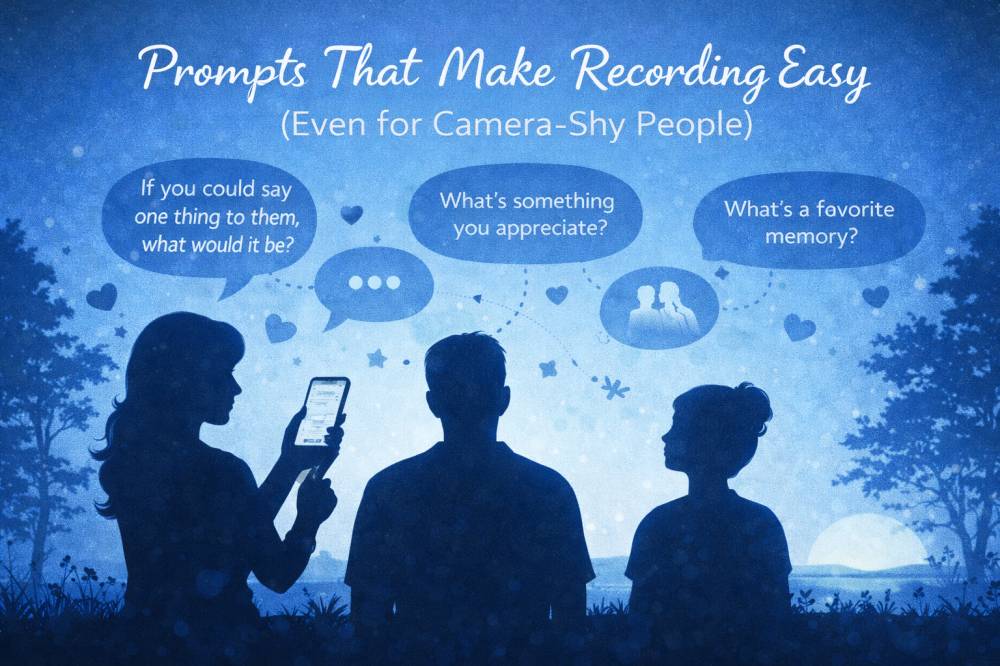
“What’s a favorite memory you share?”
-
“What’s something you admire or appreciate?”
-
“What’s one thing you hope for them in the next chapter?”
-
“What’s a moment that still makes you smile?”
-
“If you could say one thing directly to them today, what would it be?”
Let contributors choose. Choice lowers pressure.
Prompts by tone (pick the one that fits)
Warm and celebratory
-
“What makes them special to you?”
-
“What’s something you’re grateful for in your relationship with them?”
Reflective
-
“What’s something you’ve learned from them?”
-
“What’s a moment that stayed with you over the years?”
Light and simple
-
“What’s a memory that always makes you laugh?”
-
“What’s one word you’d use to describe them—and why?”
Collect video messages from friends and family into one beautiful wall. Start free — pay only when you deliver.
What to tell contributors (one sentence)
Including this line helps more than you’d expect:
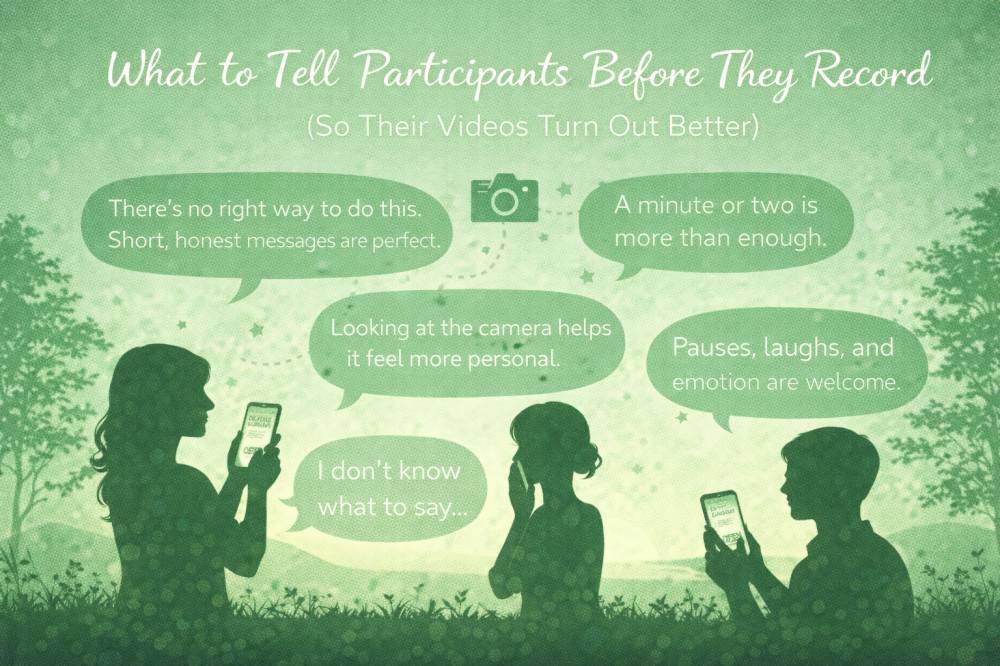
Short and imperfect is better than long and polished.
It gives people permission to stop overthinking.
How long should messages be?
-
30–60 seconds is ideal
-
Under 2 minutes is still fine
-
Anything longer is optional, not expected
You don’t need to enforce time limits. Most people self-correct once they know what’s “normal.”
If someone asks, “Can I redo it?”
Yes. Always yes.
People care about getting it right because it matters. That’s a good sign.
Common worries (so you don’t carry them)
“What if the messages feel repetitive?”
Repetition isn’t a flaw—it’s reinforcement. Hearing love expressed from multiple angles is the point.
“What if some messages are awkward?”
They usually become the most endearing ones.
“What if someone goes off-topic?”
That’s okay. The recipient experiences it as presence, not structure.
Next best action
Send (or resend) your invite with one clear prompt and the reminder that short is perfect.
If you want, the next tutorial covers how to follow up without awkwardness—and without feeling like you’re nagging.
Collect video messages from friends and family into one beautiful wall. Start free — pay only when you deliver.